

Q&A by Daniel Saavedra
This summer, Fibershed teamed up with Dr. Emily Oertling from California State University, Sacramento’s Fashion Merchandising and Management program to offer a dynamic 6-week internship intensive. Focused on textile policy and advocacy, this program empowered emerging leaders to dive deep into the critical issues shaping the future of sustainable fashion. Read on to explore insights from some common misconceptions about textile recycling.
What is the Responsible Textile Recovery Act?
The Responsible Textile Recovery Act (RTRA), formerly known as SB707, is a California law that establishes a textile Extended Producer Responsibility program, holding textile producers accountable for the waste generated by their products after consumer use. This program will be managed by the textile industry and regulated by CalRecycle. Under the law, companies selling textiles in California must:
-
Create and join a Producer Responsibility Organizations (PROs), collecting annual fees to financially support the EPR program;
-
Set up collection, sorting, repair, reuse, and other textile management infrastructure for used textiles with the goal of landfill diversion;
-
Provide public education on responsible disposal, repair, and reuse;
-
Publicly report annually on their progress; otherwise, they will meet fines for noncompliance.
The RTRA acknowledges that recycling alone is not a viable solution. By introducing repair and reuse as legitimate recovery pathways, it opens the door for more circular alternatives. This includes supporting the infrastructure necessary to collect and sort post-consumer textile products, as well as investing in regional repair and reuse operations. Redirecting these fibers away from landfills and back into local production loops could be a significant key to a more sustainable future (Cao et al., 2022). While RTRA addresses post-consumer waste, it does not address the deeper problem of mass overproduction and the dominance of synthetic textiles.
It’s a response to the symptoms but not a cure for the system.
To stay up to date on the progress of the Responsible Textile Recovery Act, visit CalRecycle’s website and join their mailing list.
Who is Fibershed? What role do they play?
Fibershed is a nonprofit based in Point Reyes Station, CA that promotes soil-to-soil and place-based textile systems. They advocate for the production of natural fibers, the development of regional economies, and climate-beneficial farming practices. Fibershed supported the development of SB707 (now RTRA), recognizing that recycling myths distract from deeper, systematic change. Their model connects fiber farmers, mills, dyers, artisans, and designers, demonstrating that an ethical circular textile system isn’t just possible; it’s already happening.
Does textile recycling work?
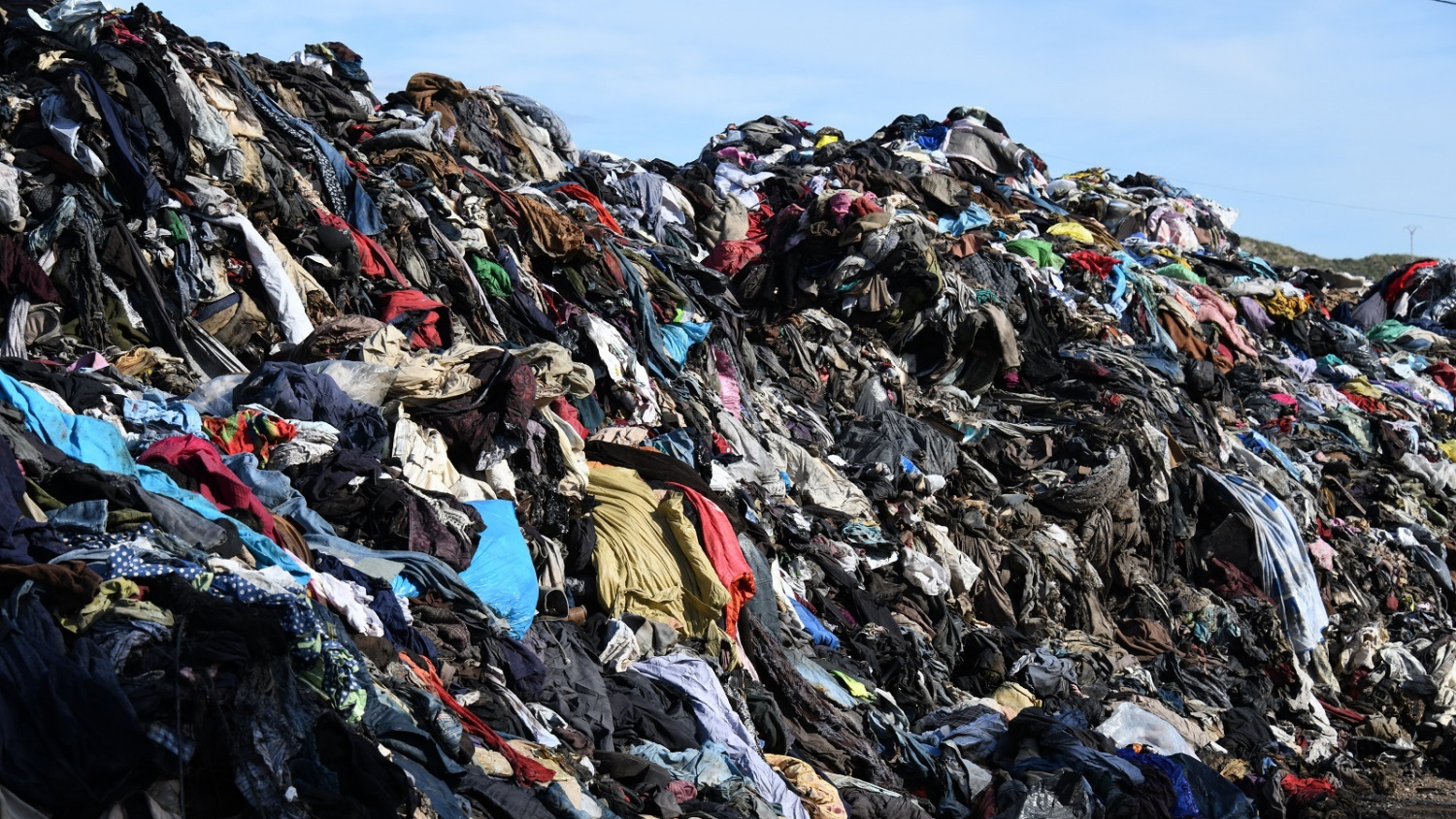
The idea of recycling clothes may sound great in theory, but in reality, most textile recycling processes are ineffective.
The most common method is mechanical recycling (MR), which involves sorting garments and then shredding them (Undas et al., 2022). Although MR works well with 100% natural fibers, such as wool and cotton, most textiles produced today are made of synthetic fiber blends (also known as plastics, like polyester and nylon) or a blend of both natural and synthetic materials. Since the blends are difficult to separate, manual sorting is the industry standard, but is often slow, inaccurate, and inefficient (Nemeša et al., 2024). When sorting textiles, blended garments are usually considered worthless; instead, they are landfilled or incinerated rather than being recycled (Geyer et al., 2017). Taking into account that synthetic clothes shed microplastics during their consumer usage phase, you can imagine that synthetic textiles will also shed microplastics during shredding and continue releasing them throughout reuse, rewash, and waste cycles.
What is advanced or chemical recycling? Does that work?
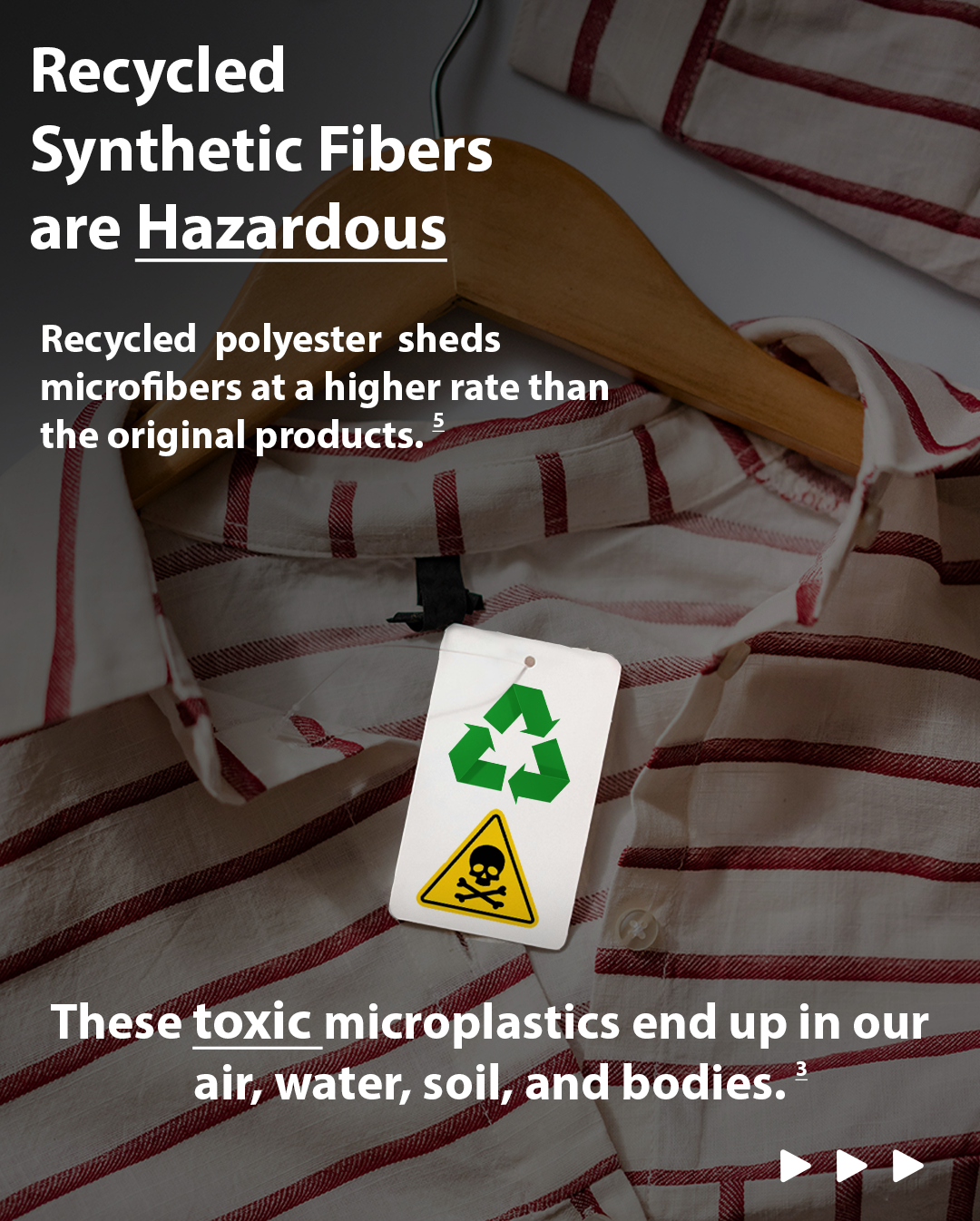
In short, not really!
Advanced (also known as chemical) recycling may sound high-tech, but it’s far from a solution to sustainable textile recycling. These processes use high heat and toxic solvents to break down synthetic fibers, which often release hazardous byproducts and expose workers to toxic chemicals to create low-value materials that rarely ever replace virgin plastics.
Manivannan et al., (2025) found that chemical recycling of blended fabrics releases tens of thousands of microplastic fibers per gram, most commonly during the dye removal process. These particles become surface-modified, meaning they bind to pollutants more easily and stay in the environment longer, often enhancing preexisting environmental issues.
To put it simply, recycling synthetics doesn’t make them sustainable but instead creates a “pollution pathway.”
Isn’t textile recycling circular? What’s circularity anyway?
Recycling alone ≠ circularity!
The definition of circularity is debated. In summary, or perhaps in hope, circularity means designing systems where textiles are kept in use for as long as possible and then safely reintroduced into the economy or environment through reuse, mechanical recycling, or composting. As it stands, most current textile recycling practices have harmful byproducts, like microplastics and toxins. The recycling of textiles, especially synthetics, can’t truly be circular.
We need to address the dominance of synthetics in the industry and design for longevity and recyclability from the start! Until that happens, circularity will remain part of the recycling myth.
Can any fibers be recycled?
This is where the real solution lies.
Today, polyester is the dominant fiber worldwide, accounting for over 70% of global textile production (Textile Exchange). Synthetics don’t biodegrade, can’t be recycled more than a few times (if at all), and often end up being downcycled into lesser-quality products or thrown away.
Cotton, wool, and other natural fibers are biodegradable and can be mechanically recycled into new products with significantly fewer harmful impacts. Research from Cao et al., (2022) demonstrated that 100% cotton is able to be shredded, re-spun, and reknit into viable new textiles without the use of harsh chemicals. This process offers a truly circular approach. Unlike synthetics that resist decomposition for centuries, embracing regenerative fiber systems could significantly reduce long-term textile waste and environmental harm. Despite this potential, natural fibers are becoming underutilized.
What is greenwashing?

Greenwashing is when companies market themselves as eco-friendly without actually making meaningful contributions to environmental change. Think of buzzwords like “conscious,” “green,” or “responsible” slapped on clothing tags without any real proof (FTC). Many brands promote small “sustainable” collections while continuing to mass-produce low-quality synthetics, which often end up in landfills or incinerators.
Recently, the EU’s Green Claims Directive has focused on this, calling out vague eco claims like “climate neutral” or “environmentally friendly”. Companies are required by law to have these statements backed by data. No more hiding behind marketing or vague sustainability claims! Maybe? Brands can misuse third-party certifications and lifestyle assessments to appear sustainable (Ahkil, 2024). For instance, when a company uses recycled polyester, but overlooks entirely the emissions and microplastic pollution associated with its production and use.
How does greenwashing impact me?
Greenwashing misleads consumers into thinking that buying “eco-friendly” fast fashion is a solution. When in reality, buying less and buying better is the most effective approach. By purchasing “recycled” or “green” clothing made from synthetics, as a consumer, you unknowingly contribute to pollution, microplastics, and climate harm (Fibershed, 2022). Worse, greenwashing prevents large-scale change by allowing corporations to appear sustainable without addressing the real roots of the problem: the overproduction of low-quality clothing made from fossil fuel-based synthetics, a lack of transparency, and inadequate investment in natural, regenerative textiles.
How can I advocate for a better fashion system?
Real advocacy starts by demanding transparency and rejecting vague sustainability claims. It means challenging the fast fashion model and actively supporting local, regenerative textile systems, like those by the Fibershed network. As such, to shift towards a truly circular, soil-to-soil textile economy, we must:
-
Refuse to accept recycling as a solution
-
Prioritize natural fibers and dyes
-
Call out greenwashing
-
Invest in reuse, repair, and upcycling
-
Buy less, buy better
The Responsible Textile Recovery Act (RTRA) is a California law that aims to address some of these goals by holding producers accountable for the lifecycle of their products. Stay tuned for Fibershed’s involvement and advocacy with the RTRA!
Resources
- CalRecycle: Textile Stewardship
- Textile and Product Development from End-of-Use Cotton Apparel: A Study to Reclaim Value from Waste
- Safety of recycled plastics and textiles: Review on the detection, identification and safety assessment of contaminants
- Production, use, and fate of all plastics ever made
- Production, use, and fate of all plastics ever made
- FTC: Green Guides
- EU: Green claims
- GreenStory: The Reality of Greenwashing in the Fashion Industry