

Words by Navit Reid, Photography by Paige Green
Richard Felipe had a hunch things could be different. As a fourth generation farmer, he’d spent his life doing things the way his father had done them, the way everyone around him was doing in the sun rich but water poor San Joaquin Valley. He followed all the spraying schedules and tilled the soil to keep the pests down, the weeds out, and his pistachio trees dosed with fertilizer to make them healthy. But margins were getting tighter, and he just wasn’t sure what future there was to be found in his family’s 200 acre pistachio orchard. Standing at a crossroads, he started looking for a different path, one that would give his own children a future on their farm in an ever shifting world.
This led him to explore regenerative farming, and the more he learned, the more he became convinced this could be a way forward. He slowly started trying a few regenerative practices out, but was still unsure whether it was worth the risk. Then in 2022 his neighbor, also a fourth generation farmer, went out of business and suddenly it became all too clear that his farm could be next. Richard knew it was time to dive deep and try everything he could to turn things around, “That moment pushed me to move faster and commit fully. Looking back, I truly believe I’m still here today because of those decisions. That neighbor is gone now, and when I look across the fence line I often wonder, “What if?”
Changing things offered no easy task. After decades of farming, where regular discing ripped up the rich ecosystems in the topsoil and constant tractor use for spraying and harvest compacted the soil, the land in Richard’s orchard was hard as a rock. This meant when it rained or the trees were irrigated, water took much longer to infiltrate the soil, if it went in at all. In an area that usually only gets 5-16 inches of rain per year, every drop mattered. To irrigate all 200 acres took weeks of continuous watering. In the heat of summer, when temperatures regularly stayed over 100 degrees, it was hard to keep up. By the time they finished with one end of the orchard, it was time to go back and start watering all over again.
In his journey to bring health back to his pistachio trees, Richard eventually threw the entire playbook out and began to write his own. He started by asking questions, researching online, and exploring ways to bring the land back to life. This led him to start experimenting with cover cropping, sheep integration, compost, and producing his own Indigenous Microorganisms (IMO). Richard knew all this presented a huge risk. As he began to implement more regenerative practices, there was considerable trial and error. Today he is emphatic that any grower considering such a path should be aware that a transition like this is not always a smooth process. But he believed the change was worth the risk, so he stuck with it and gradually started to see surprising and significant results.
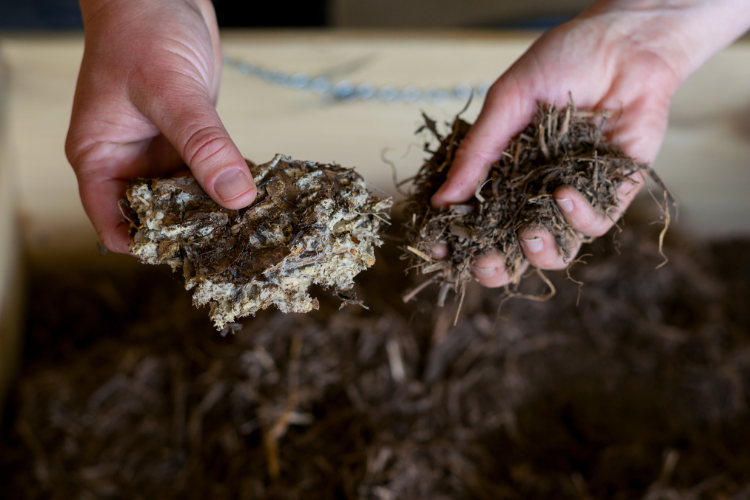
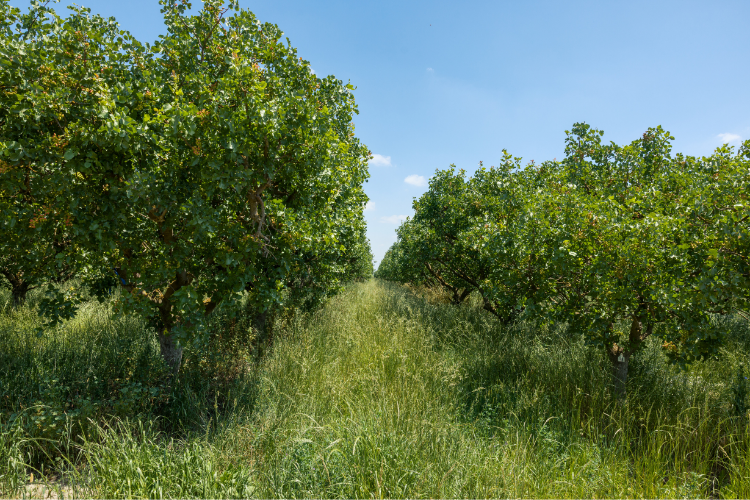
Once he started questioning things, Richard quickly realized that to make his trees healthy, he had to make sure the soil the trees were growing in was also healthy. So even though everyone around him said it was a recipe for disaster, he began to cut back on spraying herbicides and pesticides, thinking that if you stop focusing on killing things and more on growing things it would lead him in the right direction. At the same time, he started spreading compost and IMO and immediately noticed the difference. The compost and IMO added back in the bacteria, fungi, and protozoa that are so crucial to a functioning ecosystem below ground – an ecosystem that for years had been suppressed and destroyed by the continual application of synthetic chemicals above ground. By removing chemicals and adding in these beneficial microbes, the alleys between the rows of trees sprung back to life. To encourage this, Richard also started planting a cover crop between his trees to help protect the soil and encourage nutrient cycling with the newly re-introduced microbes. With this combination, he saw things really start to take off.
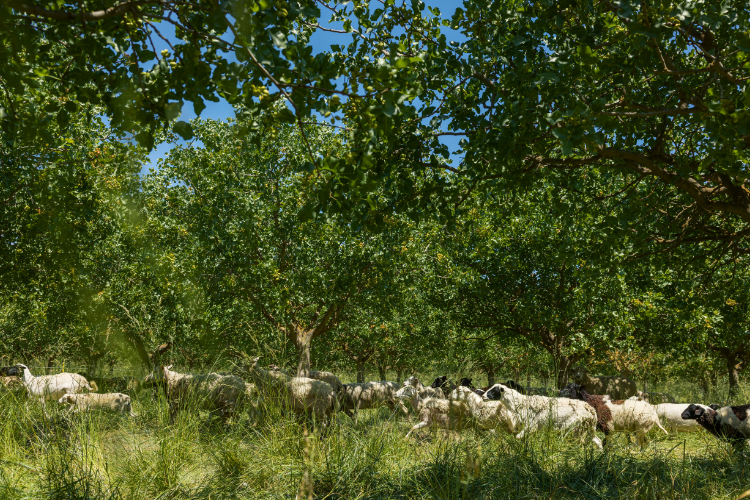
Before long Richard’s cover crop grew to be so lush and tall that he needed a way to mow it down. Using a mower was one option, but cutting it left a mat on the orchard floor that didn’t actually integrate the plant matter with the soil and tended to trap moisture in a soupy mess, so he turned to an interesting alternative: sheep. Working with contract grazers, Richard brought in 100-200 sheep to graze down his cover crop, removing the biomass in time for harvest in the fall, while also integrating the crop residue into the soil through the disturbance from their hooves. Timing was an issue, finding a grazier available when his cover crop was at its peak, and long enough before harvest was tricky. So was juggling the continual production process of the IMO and the availability of compost to get it delivered at the right time with the winter rains. But the results were undeniable: the roots of the plants in the cover crop and the microbes from the IMO and compost were opening up the soil. Moisture was going into the soil faster and being stored for longer, and the pistachio trees were looking better with each growing season.
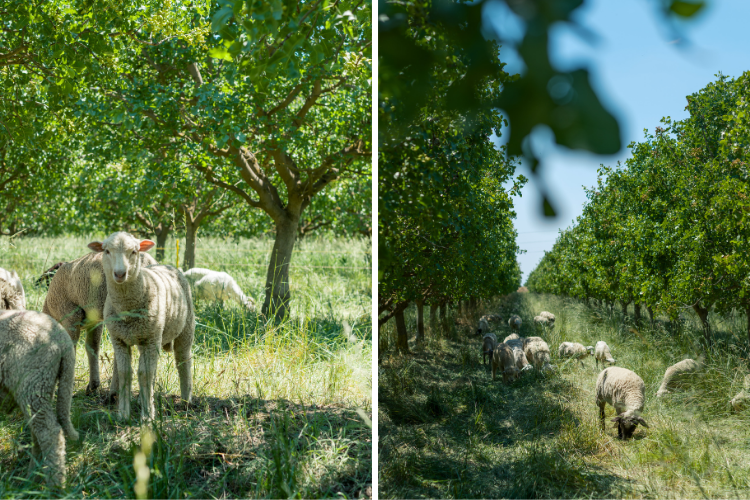
In the midst of all this, Richard also learned about government incentive programs that help offset the costs of trying out new approaches, which were a good fit for his interest in rebuilding soil health. Though previously skeptical of government programs, they offered an important financial buffer to shifting his practices, so Richard decided to give them a try. By working with Wild Farm Alliance, he joined the California Department of Food and Agriculture’s Pollinator Habitat Program for support with his cover crop, and through Fibershed he joined the Healthy Soils Program for support in spreading compost. By working with these non-profits which were administering state funding, Richard was able to receive annual grant funding for 3 years for completing these practices, as well as free assistance in navigating the program’s application and administrative processes.
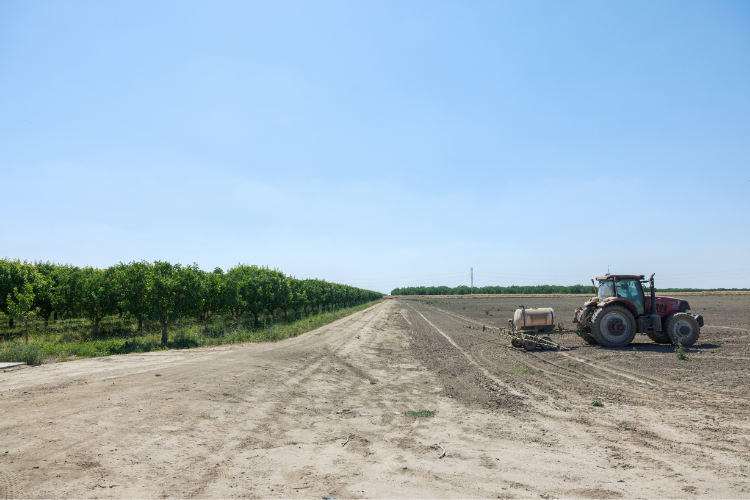
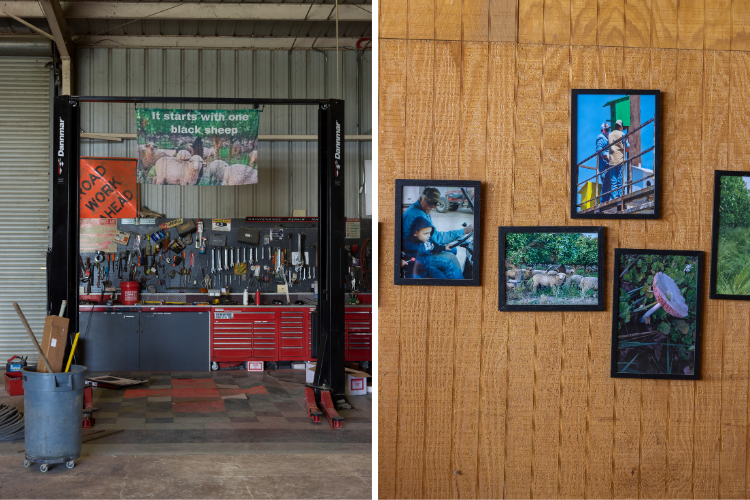
At a site visit this spring, Richard proudly points to the tractors parked in his barn, “This time of year we’d normally be out with these every day spraying. Now they sit there most of the time, which I don’t mind given the fuel prices nowadays.” After using no synthetic inputs for the past 4 years and witnessing the drastic improvement in his orchard’s production and overall health with his other efforts, Richard’s entire operation has transformed: “I’ve shifted the way I’m thinking. I don’t farm pistachios – I farm microbes. Healthy microbes drive nutrient cycling, creating healthier soils and more productive trees”.
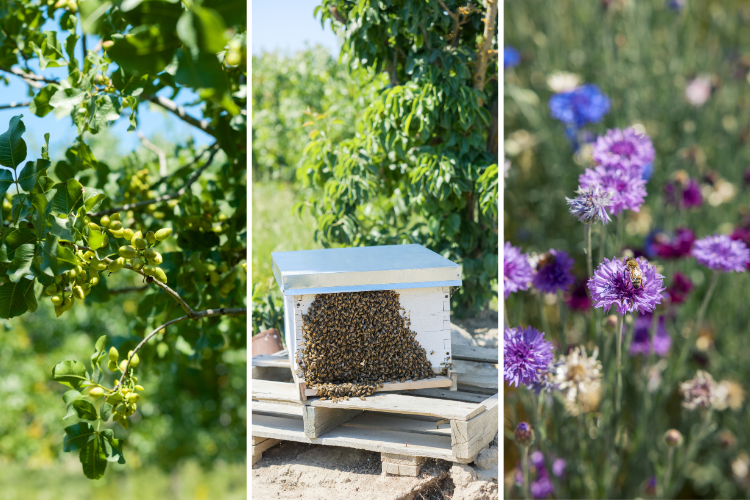
The cover crop now self-seeds itself, and on a late spring day hums with butterflies, bees, and other pollinators underneath the canopy of trees heavy with nuts. Today Richard uses 20% less water to irrigate his trees while still relying on the same flood irrigation system he’s always used, and is on track to have his best ever pistachio harvest. The harvest won’t count for much until the nuts are fully off the trees this fall, but in an especially tough year when few pistachio farmers have much of a crop to speak of, they’re a clear sign that he’s on the right track, “The reduction in conventional input costs has certainly helped, but what excites me most is what we’re seeing in the orchard today. As our soils have become healthier, we’re seeing more life, stronger tree growth, and possibilities we never imagined” Richard says.
Grazing with sheep has worked so well, that Richard took another big leap of faith this year and started his own herd. Now the proud owner of 125 head of sheep, he’s starting to think about all the different possibilities of using the wool they produce. Should he turn it into pellets to mulch around the trees? Mix it with his compost? Pool it with other wool producers in the state to sell it in bulk for filler in furniture and insulation? Process and spin it into yarn to sell in his family’s on-farm shop?
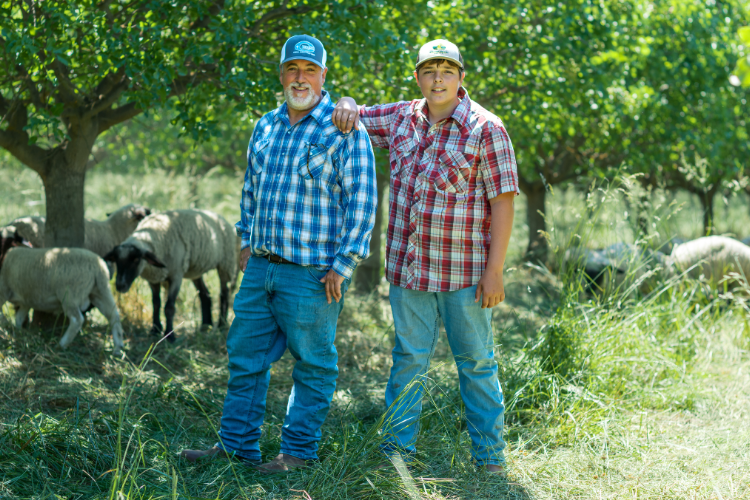
Adding in a whole new line of production is a huge undertaking, and Richard is the first to admit he doesn’t have it all figured out. In time he’ll better understand the best ways to fit the sheep into his operation for his business and family. With all the butterflies and other pollinators showing up to feed on his cover crop, he also wants to start making honey. But despite the many question marks still lingering and all the pitfalls he’s had to overcome to get this far, he says something striking: “I’m excited about the future, and not a lot of farmers can say that these days.”