

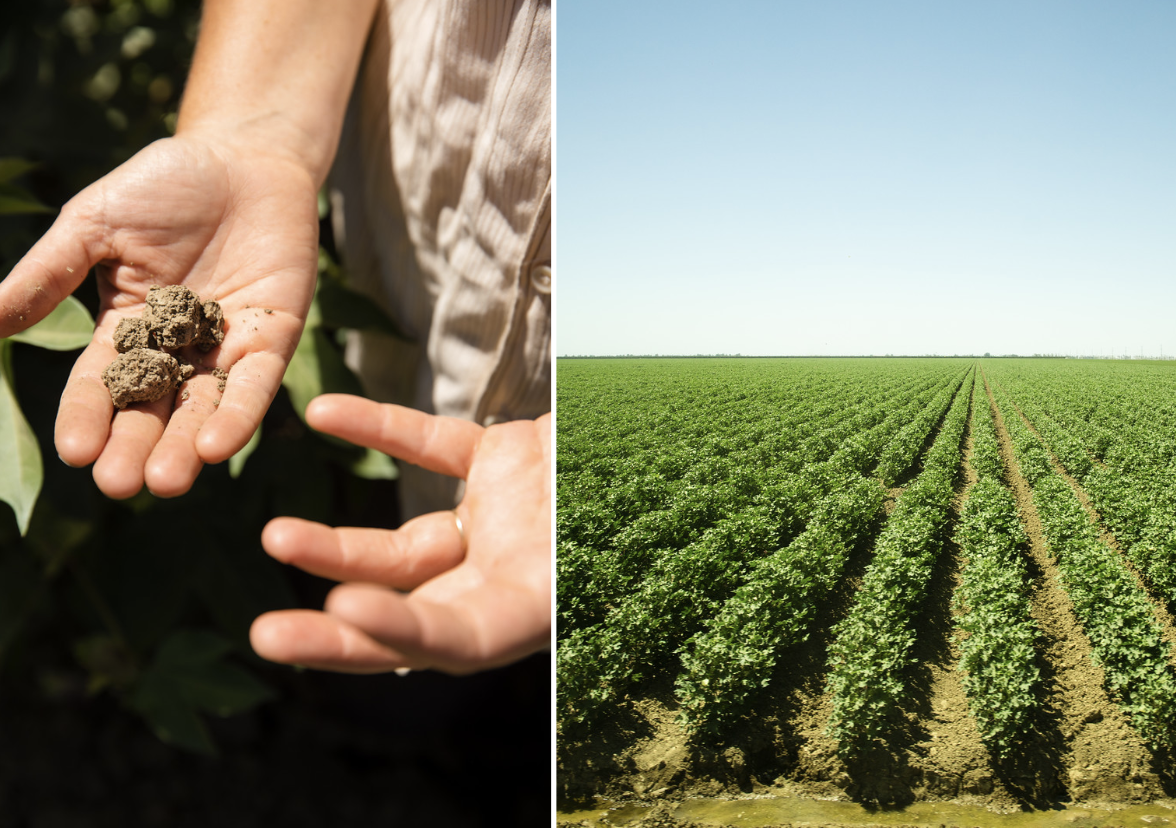
Across the world, organic farmland is estimated to account for just 2.1% of total farmland. It accounts for less than 1% in the United States. And these low numbers have stayed troublingly static, even as consumer demand for “better” food and fiber has skyrocketed over the same period.
Why the inertia? Because transition is difficult when the risks are asymmetric. Conventional growers operate on razor-thin margins, and the upfront costs of new seed, new equipment, new certification, and—most crucially—the period of lower yields while soils recalibrate, can break a farm that’s already fighting volatile markets and an unpredictable climate.
That’s why the real work of our era isn’t simply cheering for organic. It’s also going to take standing shoulder-to-shoulder with conventional producers and building economic pathways that de-risk their journey into truly regenerative farming practices:
- Long term ‘pre-planting or pre-shearing’ purchase agreements that give farmers the confidence and ability to experiment without betting the farm—literally—on next season’s spot price or unclear market commitments.
- Outcome-informed financing that rewards measurable gains in soil carbon, biodiversity, and water retention instead of prescribing one-size-fits-all practices.
- Integrated technical support so that the agronomists, state and federal funding agencies, and markets are solving problems together rather than handing the farmer three separate playbooks.

And let’s be honest: there are many examples where organic production can go further. Farming with fewer synthetic inputs is a step, but farming to actively rebuild soil carbon and ecosystem complexity is the future. Whether a field carries the organic seal or not, the litmus test is whether it leaves the land more resilient for the next generation.
To make this change a reality, consumers are in the driver’s seat.
When shoppers, brands, and investors align behind a clear message—“Show me how this product supports living soil and a thriving farmer”—businesses will race to meet that expectation. We’ve seen consumers help drive new and different sectors such as renewable energy, and we can see it in agriculture, too.
Will it require real capital investment? Absolutely. Will it demand patience in a quarterly-report-driven world? Without question. But agriculture is a centennial proposition: the decisions we sponsor today will echo through the harvests that will be enjoyed by our grandchildren.

If we can create consensus across supply chains, policy tables, and dinner tables that soil health, farm profitability, and climate resilience are non-negotiable co-benefits, we stand a genuine chance of bending the arc of global agriculture toward regeneration.
The opportunity isn’t simply to fix a broken system, it’s to support the transition to an entirely new approach that restores the earth even as it feeds and clothes humanity.
That’s work worth doing.