

Written by Stephany Wilkes. Photography by Paige Green.
I recently sat down for a conversation with brilliant natural dyer, artist, creator – and now author – Heidi Iverson of Honeyfolk. We talked about The Natural Dye Handbook, plants and land observations, climate trauma, balancing publishing needs with natural seasons, and lots more.
SW: How are you doing post publication? What do you get to do with your time now?
HI: I’m excited to sew! Honestly, it will be a year of healing, seeing friends, hanging out, being able to enjoy natural dyes again – all the things you don’t get to do while publishing a book. Do not try to illustrate your own book while making dye samples and writing it, that’s my advice (though I’m really good at drawing plants now, at least in my style). And, I don’t know if anyone knows this, but you do not make money writing a book!
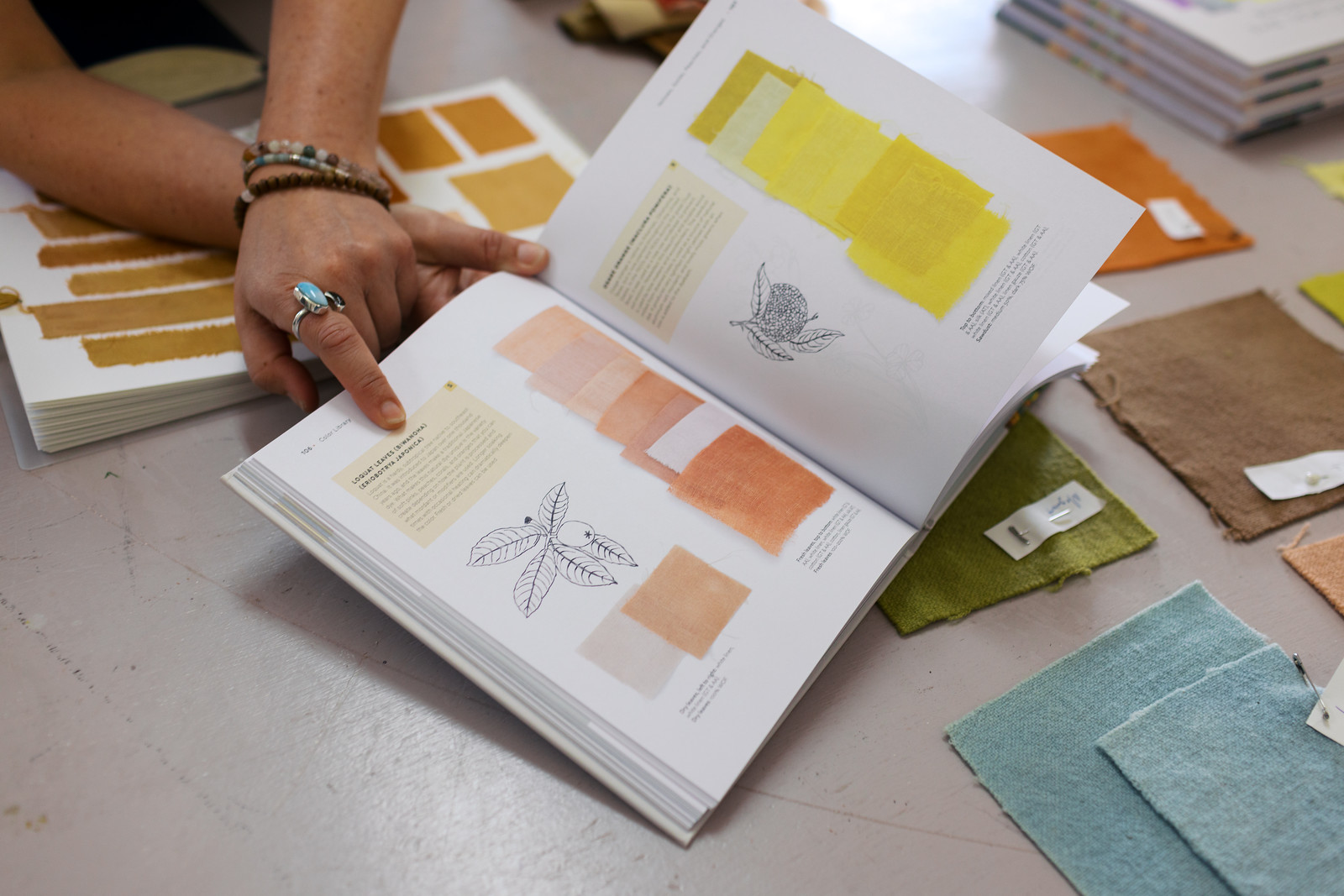
SW: Oh, I do know. You’ve said that you spent just as much time dyeing fabric samples as you did writing and illustrating the book, and that your favorite part of the The Natural Dye Handbook is the color library. I believe there are 75 different dyes in the library, and each dye has at least six samples… That is 450 samples, not counting those that didn’t make it into the book. How did you go about making and organizing all of this?
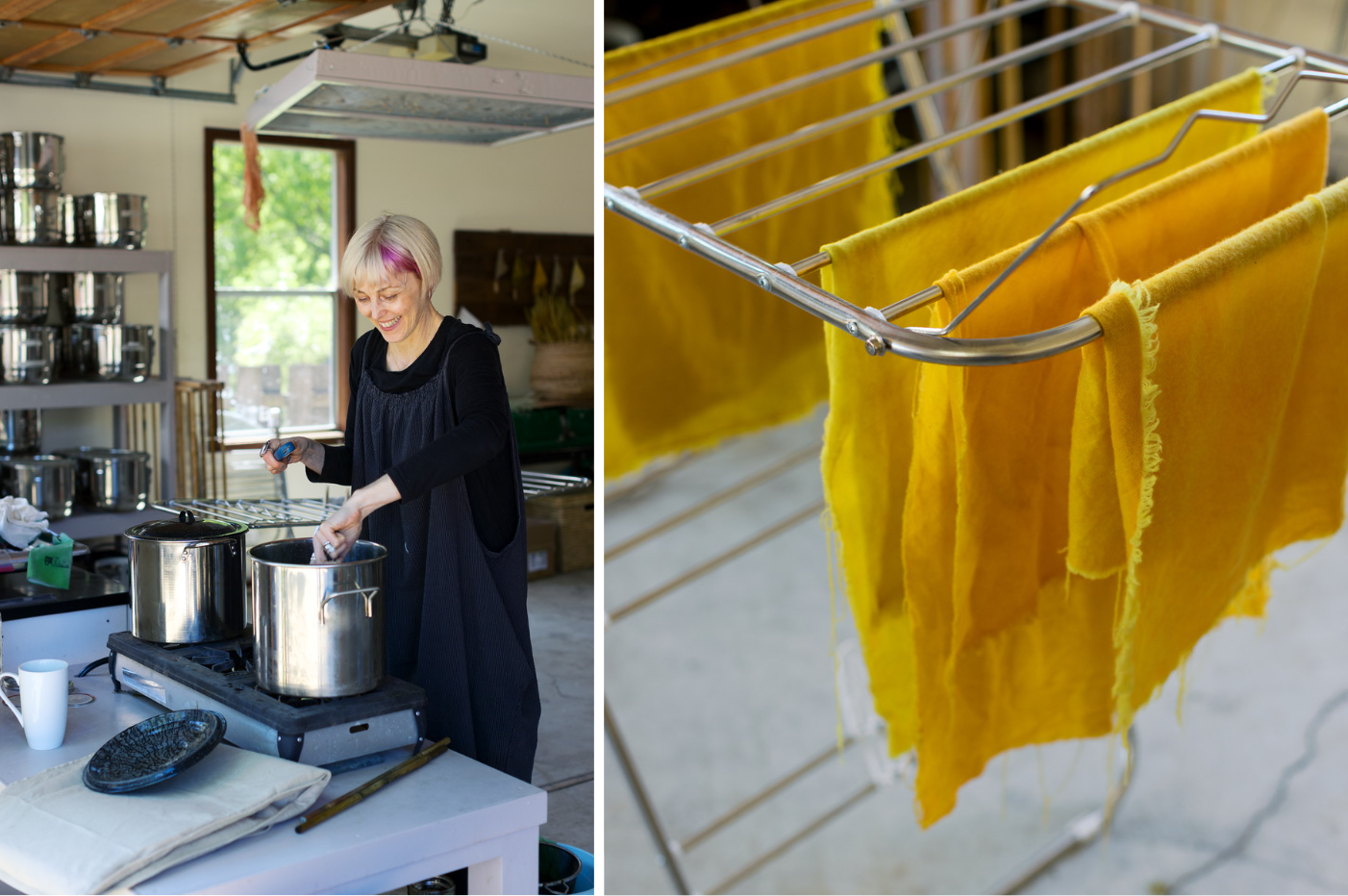
HI: There are even more samples than that in the book – probably closer to 750. It was bonkers. I came up with a system using colored stitched markers (which is also in the book) to keep track of the different processes and what I used. I also labeled everything meticulously. I had a chart in Google Docs and handwritten charts on giant pieces of paper on my studio walls so I could track everything. I don’t actually know how much time I spent doing dyework. It happened over many months. I would process plants according to harvesting times. Sometimes it was insanity, and sometimes it was just a few. It was easier to do the commercially available plants, because I could plan that out. The labeling was the hardest. My friend Lily helped me for six hours one day. Plus I did more on my own.
SW: If memory serves, you were – forgive – on the bleeding edge of natural dyeing, in a pre-Instagram, pre-Fibershed world. You’ve been doing your thing, consistently, for a while now. Can you say a bit about where your natural dye journey began and how you got here?
HI: My natural dye journey started when I took a spinning and natural dye class at Windrush Farms. I knew Marlie de Swart from a ceramics co-op we both belonged to. She knew I was interested in spinning and told me about the class. Later, I met Rebecca Burgess while she was writing her first book, Harvesting Color. She needed someone to design and write knitting patterns for it, and photographer Paige Green introduced us. It was all pre-Fibershed. I took a natural dye class with Rebecca as well, I just don’t remember exactly when. It was so long ago.
SW: Natural dyes have become a little more mainstream than they were 15+ years ago. How did this particular book come about, at this particular time?
HI: In 2021 an editor from The Quarto Group, a global, illustrated-book publishing group, found me through Instagram. She offered me the opportunity to write a book about slow stitching and natural dyeing. That book proposal didn’t get picked up by a publisher. The Natural Dye Handbook was the second book proposal I wrote. In 2024, a commissioning editor approached me about writing a more advanced dye book. It was supposed to be a teaser proposal. I wasn’t expecting it to get picked up by a publisher immediately, but it did. It happened very quickly. I really wanted another year to do more research and experiments. We were just recovering from the drought and wildfires, and I could see the change in harvesting times and how the rain was impacting some of the colors.
SW: Can you say more about that? What have you noticed?
HI: Plants have changed so much post fire, post drought. Last year the plants bloomed late and this year they’re early. I didn’t see little wild calendula, field marigold, for two years, and then when I did they were in another place, not where they used to be. With loquat leaves and cedar, I got different colors during the drought – more concentrated, brighter colors. Because the trees had less water in them, the pigments were stronger, already more concentrated in the leaves and the trees. The cedar was a very bright yellow. And redwood cones were everywhere. The squirrels were eating them because they didn’t have as much food, and the cones were falling down all over the place – I was picking them up off the road. And we have different squirrels now, I think because of the fires.
SW: Yes! The ‘Doug Fir squirrels?’ That is what I call them, anyway.
HI: Yes. I thought they were a new kind of bird at first, due to the sound they made. This year we have so many more birds.
SW: Thanks to two good rain years, I think. We can’t sleep through the dawn chorus.
I’m still traumatized from the drought and the fires. I can’t think about another drought.
HI: I know. Last year was the first year I didn’t cry when it started to rain. It’s been so wet this year, for so long, that I want to test the plants again. That is part of what made publication so challenging. The publisher would ask for a photo of dock root seeds, for example, and I’d say ‘There are none left, they’re gone.’ Or ‘Can you get a photo of XYZ’ and it was not the season – and my season is totally different now. There are water pH changes when it rains a lot too, I think, and water really affects dye outcomes. There are so many variables. A lot of my students and Patreon supporters have iron in their water, and that will always affect things. If you have a dehumidifier, the water you get is pH neutral and distilled – it is perfect water to use for dyeing.
SW: Your book mentions two different approaches to natural dyeing, a traditional style and a more intuitive approach. Can you say more about those, especially the latter?
HI: The traditional ratio method uses specific weights of dye stuff and fabric. Dry fabric is weighed and a specific amount of dye stuff, or extract, is calculated based on the weight of fabric (WOF). The dye is extracted in a heated water bath. This is very straightforward. There are still variations from bath to bath – especially if you buy from different sources. For the most consistent results, you should always buy from the same source, do a test swatch, and record the results in your dye journal.
The intuitive folk method is one of the simplest ways to explore natural colors from your landscape and discover plants you can use for natural dyeing. It’s based on the folk method of medicine making. I like to think of it as plant magic + earth magic + forest magic = a kaleidoscope of colors. The folk method doesn’t have specific measurements, only parts. There is no difficult math involved. You don’t need to meticulously weigh everything, with the exception of mordants. As you grow as a natural dyer, you will eventually rely on your intuition and knowledge to craft color. With this method, there may be more variation from bath to bath. It’s a good idea to always keep fabric swatches and notes in your dye journal because results from foraged plants can differ depending on the time of year gathered, soil type, climate, and weather. This method is simple and is best suited for plants you either gather or grow. You would not use this method with expensive natural dye extracts, or raw dye material purchased online from a natural dye supplier.
SW: What are some dyes we might see in your book that we do not see in others? I feel like you dye with some pretty unusual things – like redwood cones. Do you have any favorites?
HI: I think you won’t find the majority of the dyes in other books. Wild Color by Jenny Dean and Dyes from American Native Plants by Lynne Richards and Ronald J. Tyrel are probably the only other books that have such an extensive color library. Both books have paint chip-style color results, not fabric samples.
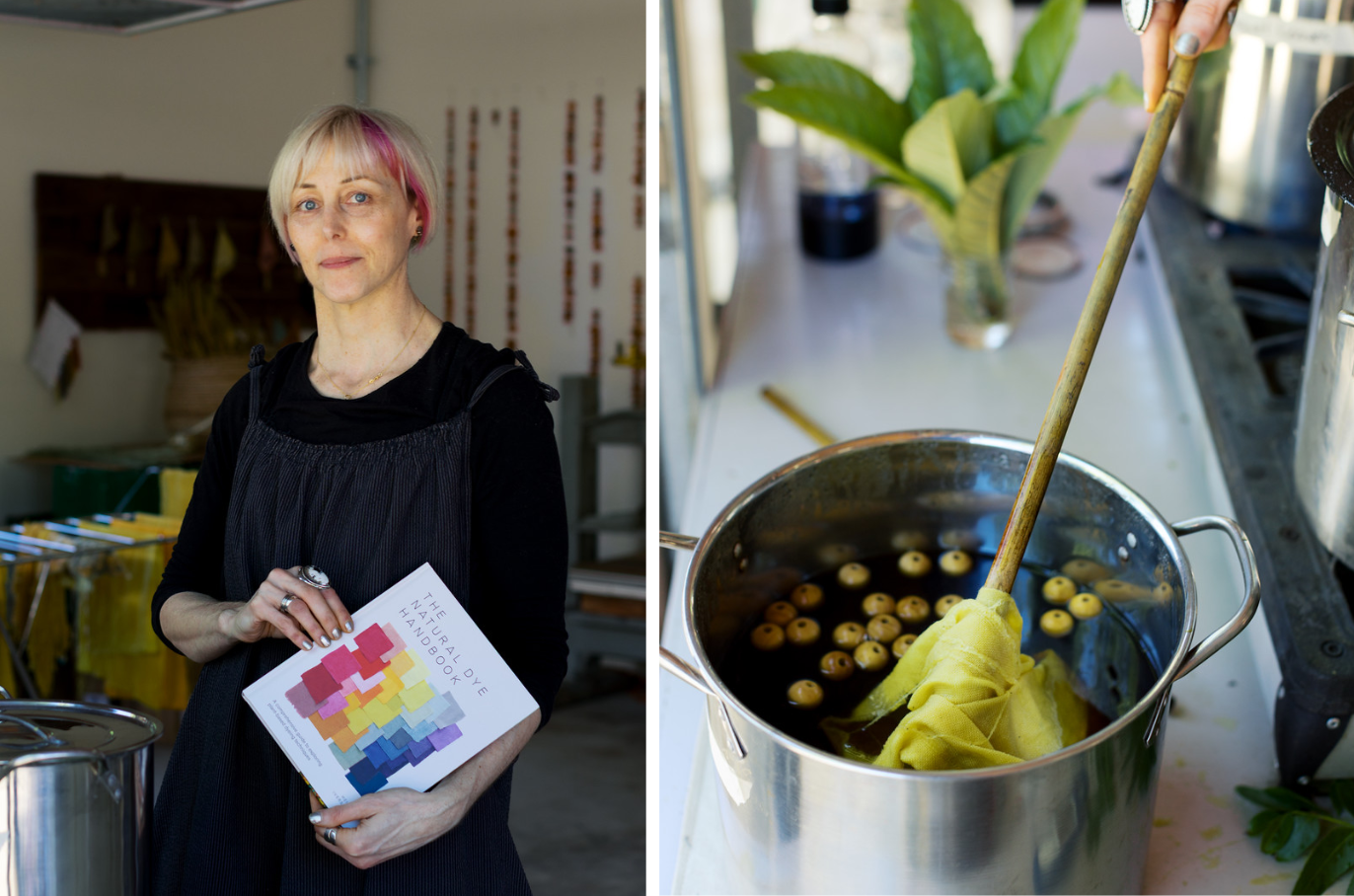
It’s hard to pick a favorite dye plant, but redwood cones are definitely one of them. I was so excited when I tested them out. They really sparked my curiosity. Loquat leaves, madrone and manzanita bark, oak galls, perícon, horsetail, and hazelnut leaves are at the top of my list. For commercially available dyes, indigo, of course, and then it would cochineal and weld. You can essentially create the colors of the rainbow, excluding blue, by combining cochineal and weld with various modifiers.
SW: Books are as much about what gets left OUT as what makes it into the final book. Was there anything you had to leave out, that you wanted to include? Publishers control so much more than authors, but authors get all the blame!
HI: I included everything I could. My main focus was cellulose fibers. Most natural dye books are written for protein fibers with a focus on wool. I always found this frustrating. Colors can look dramatically different depending on the fiber. Anyone who has dyed cellulose fibers has also learned that it’s more challenging to dye plant fibers, especially if you want rich, vibrant colors.
So much was left out. I had several moments of being really sad that there are only 160 pages. I had enough for two books. All of the things that didn’t make it into the book will be available on my Patreon. I will have a quick-reference dye chart, as well as more detailed information about plants, journaling, and color theory, and I plan to continue adding more plants and fabric samples. I also have blog posts I’ll be sharing.
SW: What do you most want people to know about your book, natural dyeing, or anything else? HI: I want people to know that sometimes magic happens when mistakes are made. Natural dyeing should be a fun, joyful process. The most important thing to remember is to manage expectations. Find the method that works best for you, but also know that it is a journey and discovery takes patience and time. You won’t always get the same results from plants you gather. Each color is a record of that plant, at that moment in time.