

Written by Stephany Wilkes. Photography by Paige Green.
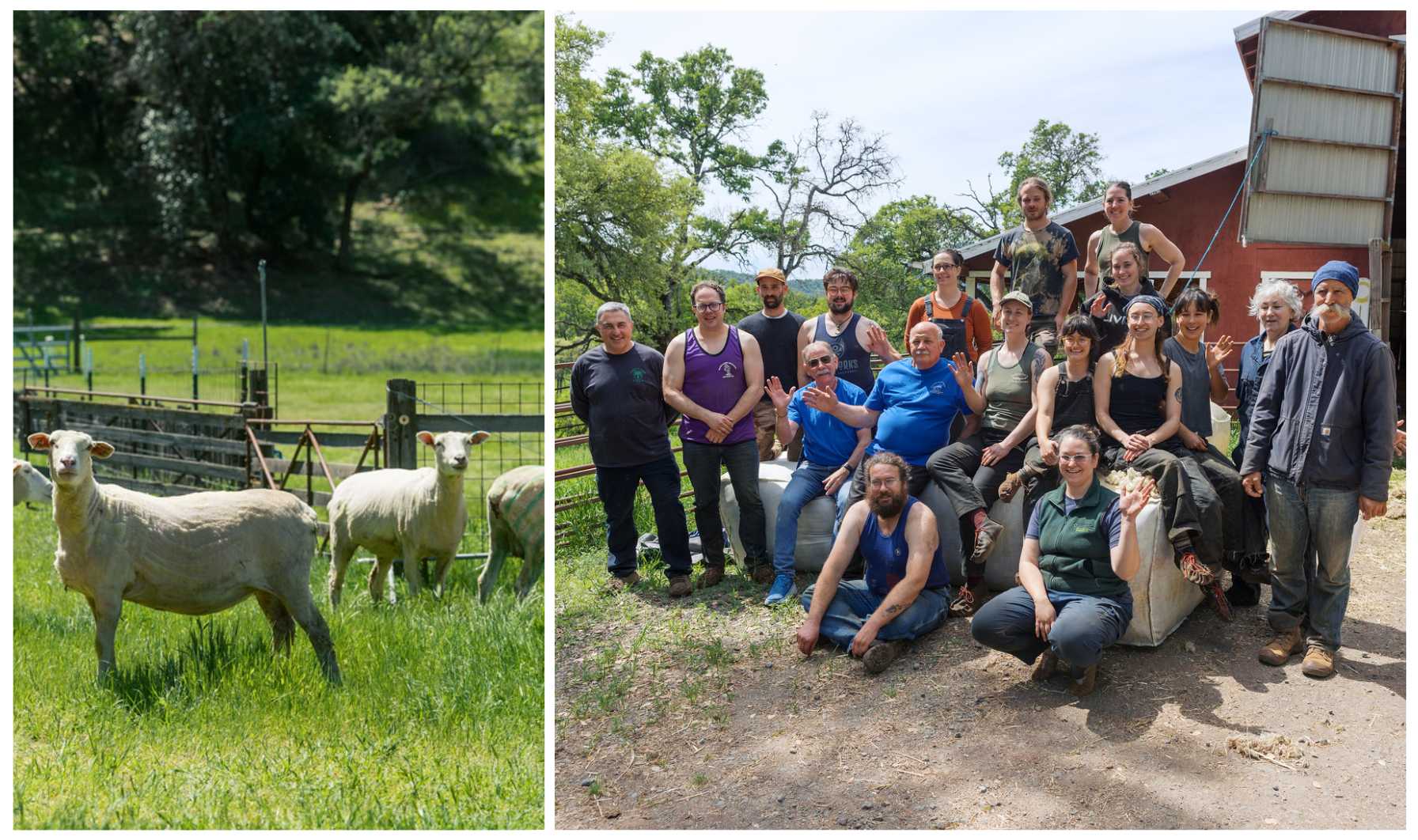
In April 2025, two dozen students attended one of two sheep shearing schools offered through the University of California Extension and supported by Fibershed. Weeklong classes were held at Pluth’s Homestead Ranch in Lake County and at the Hopland Research & Extension Center (HREC) in Mendocino County, where dedicated instructors – and several hundred sheep – provided the critical, foundational skills new shearers need.
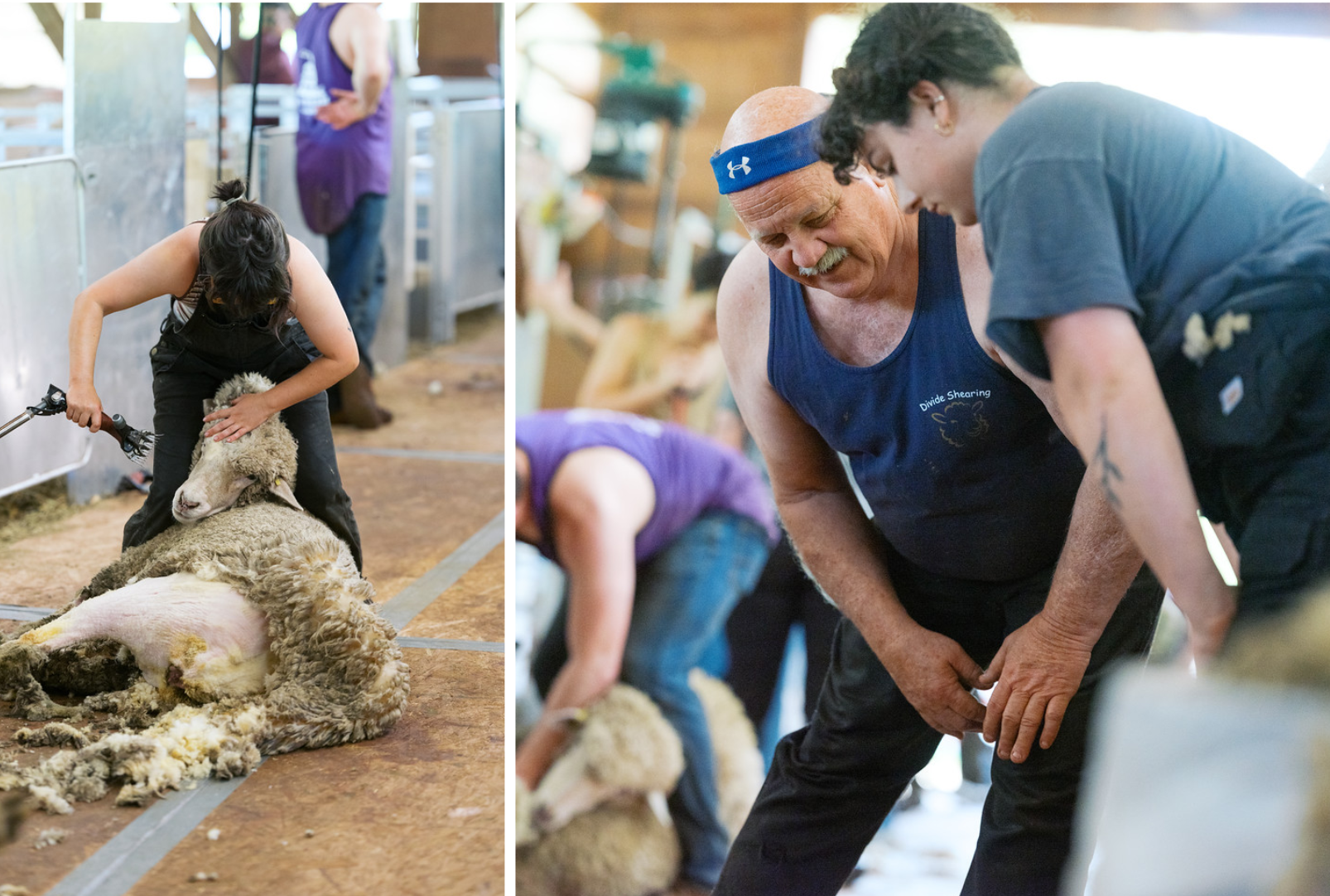
“We changed the curriculum a bit this year,” says Gary Vorderbruggen, a long-time instructor. “We wanted to maximize the hands-on time students get with the sheep. That is what students are really here for: to learn the shearing pattern while there are sheep to learn on. There was less talking and more doing.”
“Every wool garment begins with someone doing hard physical work to shear a sheep,” adds fellow instructor Dan Macon. “Shearing schools are so important in this system. Not only do they train a new generation of sheep shearers, but it gives producers (like me) a greater appreciation for the skill involved in getting wool off of our sheep. And it’s a skill that can only be learned by doing – over and over and over again. The hands-on instruction is critical.”

Jordan Reed attended shearing school in 2012-2014 and owns We Love Sheep, an established, 13-year-old shearing and agricultural services business. He visits both shearing schools each year to recruit new students, offering post-school, hands-on shearing opportunities on his extensive routes through Oregon and California.
“I’m investing in the future of shearing,” Jordan says. “I’m investing in the sheep, in the industry, creating a network of people to share jobs with, to hand work to. And shearing school is key. The focus of both schools is safe and humane handling, not getting hurt, learning how to properly set up and use equipment, and learning the safest shearing pattern, which results in a complete fleece. People need to understand how physically demanding it can be. Shearing school provides the foundation, so students can make that jump to intermediate and be more prepared and useful. You must go to school. I have taken some self-taught shearers out with me over the years and the sheep are clean enough, but they’re using the wrong equipment, wearing themselves out, risk getting hurt, and can’t shear very many in a day.”
Jenny Morris completed the class at Pluth’s this year and received a scholarship from Fibershed to do so. Less than two months later, they are in Oregon working with Jordan. “I knew I had to come out and learn it,” Jenny says, “how to talk to clients about what you need, seeing all the different farms – and every farm is different. I’m stoked – we did 131 sheep on Saturday and I did 30 of them, and they were huge!”
“Huge, old-fashioned Suffolks,” Jordan adds.
Several students returned to shearing school for the second year in a row, some – like Aaron Goulet – from quite far away, in Surrey, BC, Canada. He says, “I have one big reason for wanting to come back to the UCCE (Lake County) Shearing School: the instructors. The course itself is excellent, you can tell the program has been distilled and perfected over years of experience, but it’s the instructors that bring the program to life. When I was in my first year, I needed to understand the very basics and each instructor spent time with me to get to a place where I was confidently shearing. The reason I came back for a second year was that I wanted to build on what I had learned, now with some experience under my belt. Again, the instructors worked with me to elevate my skills to an even higher standard and add discipline to the process. I’m lucky to have found the people that will help me become a better shearer no matter where I am on the journey. I am looking forward to being back in that school barn again!”

Saill White attended the HREC school three times, in the spring and fall of 2023 and an advancement course in 2024. Since then, Saill has sheared 160 sheep and created a website and map called Community Land Shepherds, to help agricultural service providers and farmers connect more easily.
“At the start, my goal was only to shear my two sheep, because I had ten people tell me no one would come out for two Jacob ewes,” Saill says. “And the week before class Trevor, the instructor, sent an email saying, ‘This is going to be one of the most difficult weeks of your life, physically, emotionally, mentally.’ And it was. But it made us a very tight, supportive class. Five of us have remained really tight. We have sheared over 1,000 sheep between us and I can’t say who else would have sheared them. It’s hard to describe the richness added to my life, all the contacts, the adventures, how boring my life would have been the past two years without shearing. Classmate Alex is my ride or die, we’ve been through so much. We have had all kinds of adventures and I’ve been shearing at least once a week with either Alex or Jordan Reed, and several times solo! Shearing is so much safer, and more fun, when you have someone with you.”

Instructor Lora Kincade travels to Lake County from Washington state each year to teach at Pluth’s. “Shearing school has always felt like a gathering of seekers,” she says. “No matter folks’ backgrounds or goals, there’s a confluence of curiosity, drive, and gutsy-ness that consistently means a revelation of a week. I’m most interested in translating the culture of this work to folks of all kinds; I’m interested in what we have in common and what has brought us into the space and towards furthering wool and the industry. My favorite part of shearing school is when the shearing pattern clicks and you start to hear and witness students teaching each other. When we adopt a shared language and culture as a group—that part always feels like a huge success.”
Jaime and Robert Irwin donate the sheep of Kaos Sheep Outfit for the Lake County students to learn on. “They don’t all look too good at the beginning,” Jaime laughs, “with wool hanging off their legs and faces, but people have to be allowed to make mistakes. They can learn on our sheep instead of a customer’s! We trust the instructors but also know, from our own experience, that everyone makes mistakes and that’s what learning and practice are about.”
Saill recalls the last sheep sheared for her final shearing school exam at the HREC class. “Trevor said, ‘Make it a work of art and take as much time as you want.’ That’s what I remind myself of.”